
Infra-Lex Corner Dri-IR™ Cavity Wall Drying
Incident
A mid 1960’s built property with masonry cavity external walls. Within the GF Lounge of the property a micro-bore copper central heating pipe had been leaking for an unknown period. Water had saturated the screed floor though-out the Lounge and the adjacent Kitchen while also wicking up an external cavity wall in the Lounge. This incident required cavity wall drying
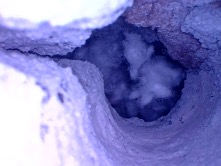
Figure 1.0 – Fibreglass type insulation within the cavity. The cavity insulation was saturated to 100mm from ground level.
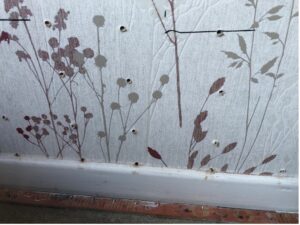
Figure 1.1 – The wall is perforated with a 6mm masonry drill to about 50% of the inner leafs total depth. On the edge of the skirting board the holes are drilled at a 45 degree angle to dry behind the skirting negating the need for removal.
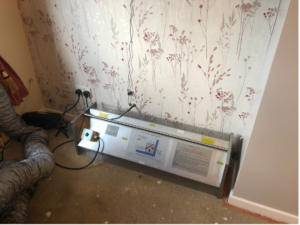
Figure 1.2 – The Corner Dri-IR™ was placed directly against the affected wall pictured in Figures 1.0 and 1.1. Temperature readings on the surface of the wall were up to 25 Celsius within half an hour.

Figure 1.3 – The data showed a steady increase of temperature and decrease in RH. The dew point before install was 13.4 Celsius with a specific humidity of 9.6g/kg. At the end of a 2 day period the dew point was 22.6 Celsius and specific humidity 17 g/kg. The Technician was aware that the temperature of the inner leaf elsewhere (and the outer leaf) will have been significantly lower than 22.6 Celsius, so there was a likelihood of condensation forming. So at this point the cavity was force ventilated to prevent secondary damage. The wall cavity had an air volume of below 2.4m3. The ventilation system was exchanging the air within the cavity at 85m2/HR. No heated or dehumidified air was used to ventilate the void.
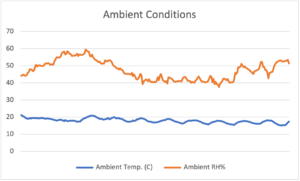
The Infra-Lex Corner Dri-IR™ allowed the wall to dry with no loud dehumidifiers, minimal strip out and very little disruption and discomfort to the home owner. Drying time 13 Days, the homeowner could keep the equipment running 24/7 due to the silent nature of the Corner Dri-IR™. The direct injection of energy is significantly more efficient when electricity cost is concerned, it also gave the drying contractor the ability to achieve significantly higher temperatures within the wall that would normally be achievable with the homeowner living in the house.